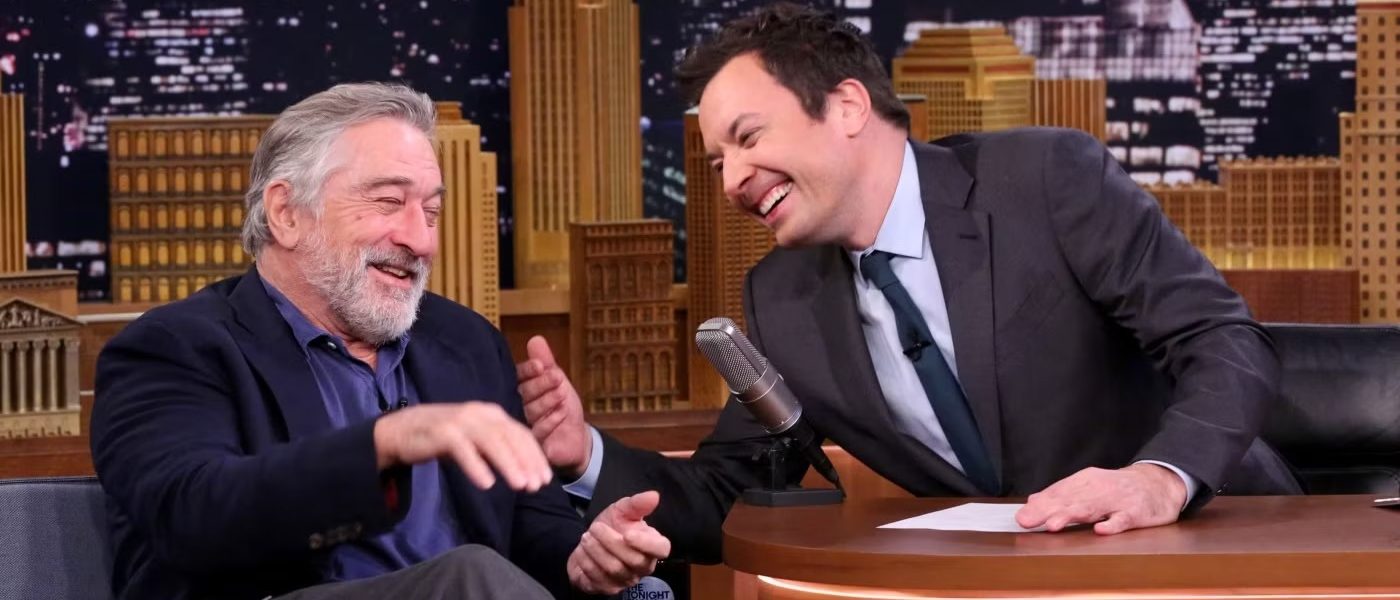

The Robert De Niro and Jimmy Fallon episode most worth rewatching is the one where Fallon pokes fun at De Niro’s famously serious persona and De Niro plays along with a calm, deadpan presence. It works so well because the humor comes from contrast rather than effort, and that makes the segment feel easy to enjoy again and again. A great late-night episode does not need a huge twist to stay memorable; it only needs strong chemistry, clear timing, and a moment that feels like it could only happen with those two people in the room. This is exactly why this pairing stands out among celebrity talk-show appearances.
Robert De Niro has one of the most recognizable acting identities in film history. For decades, he has been associated with intense roles, sharp expressions, and a kind of screen gravity that makes him feel larger than the format around him. Jimmy Fallon, on the other hand, is a host built around motion, friendliness, and comic enthusiasm. When those two styles meet, the result is not just an interview, but a tiny performance built on balance. De Niro’s seriousness gives Fallon a target, and Fallon’s playful energy gives De Niro a setting in which even the smallest reaction becomes funny.
What makes the episode especially rewatchable is that the comedy does not depend on one big joke alone. It is spread across the entire exchange. The audience watches Fallon try to keep the mood light while also testing how far he can push the bit. De Niro, rather than resisting in an exaggerated way, often lets the moment breathe. That restraint makes the joke stronger. In comedy, especially on late-night TV, timing matters more than volume. The quieter the response, the bigger the laugh can become. That is one reason viewers return to this episode: it has the kind of rhythm that rewards a second viewing.
Late-night television works best when the host and guest do not simply trade lines, but create a shape to the conversation. In this case, Fallon’s style gives the segment a sense of movement, while De Niro’s calmness gives it structure. Fallon is at his best when he is willing to be a little awkward, a little overexcited, and a little self-aware. De Niro is at his best in this setting when he treats the whole thing almost like a straight man in a comedy sketch. That dynamic creates a scene that feels larger than the actual topic being discussed. It becomes less about promotion and more about personality.
A rewatchable episode also usually has something viewers can instantly remember. In this case, it is the image of Fallon imitating De Niro or clearly trying to enter De Niro’s world of seriousness. That kind of impersonation is simple, but it works because the audience already knows who De Niro is supposed to be. There is a built-in comic tension when a host known for goofiness steps into the mannerisms of an actor known for grit and control. The humor lands because the audience understands both sides of the contrast immediately. On a first watch, people react to the novelty. On later watches, they appreciate the precision.
Another reason this episode stands out is that it captures an important truth about celebrity interviews: the best moments are often not the planned ones. A late-night guest appearance can easily become forgettable if it feels too polished or too predictable. But when a host and guest allow for small pauses, slight discomfort, or spontaneous reactions, the segment begins to feel alive. That is what happens here. De Niro’s expression, Fallon’s eagerness, and the way the two respond to each other make the whole scene feel natural. A natural scene is easier to revisit because it does not depend on a single topical reference that ages quickly.
Robert De Niro’s public image makes him especially effective in this kind of setting. Audiences associate him with authority, intensity, and dramatic weight. Because that image is so strong, any playful break from it becomes more amusing. When De Niro stays cool and understated while Fallon is doing the most, the gap between expectation and reality creates the joke. This is one of the oldest and most reliable forms of comedy. The audience laughs not because De Niro is trying to be funny in an obvious way, but because the situation itself reveals an unexpected side of his personality.
Jimmy Fallon’s contribution matters just as much. He has built his late-night style around enthusiasm, celebrity games, and conversational energy. Some hosts rely on sharp irony or political edge, but Fallon often wins with momentum and warmth. That approach is ideal for a guest like De Niro because it lets the star remain who he is while still giving the segment enough spark to be entertaining. Fallon is willing to look silly if it helps the bit. That willingness makes the episode feel generous rather than competitive. Instead of trying to dominate the guest, he creates space for the guest to become part of the joke.
The reason viewers revisit episodes like this is that they are low-friction entertainment. You do not need a deep backstory to enjoy them. You already know the personalities involved, and the humor is built into the interaction itself. That makes the segment easy to return to whenever someone wants a quick laugh or a familiar clip. Rewatch value is often overlooked in television, but it is one of the clearest signs that a moment worked. If people keep coming back, the episode has something more than novelty. It has durability.
This episode also works because it feels like a snapshot of two different kinds of stardom. De Niro represents old-school film credibility, with decades of acclaimed performances behind him. Fallon represents modern entertainment television, where celebrity access and humor are part of the format itself. When those two worlds meet, the result is interesting even beyond the joke. The audience gets a sense of cultural overlap. One figure brings history, the other brings immediacy. That combination makes the episode feel like a meeting point between eras.
There is also a comfort factor that helps explain why people rewatch it. Many fans enjoy seeing serious public figures in a lighter setting because it reminds them that celebrity image is partly performance. De Niro’s relaxed appearance on Fallon’s show gives the audience a chance to see a different version of him. Fallon’s job is to create that opening without making it feel forced. When he succeeds, the viewer feels like they have seen something that is both entertaining and slightly revealing. That mix of entertainment and glimpse is often what makes a TV moment stick.
Rewatchable comedy usually depends on small details. A glance. A pause. A change in tone. An expression that lasts just a little too long. This episode has those details in abundance. De Niro’s stillness becomes funny because Fallon keeps moving. Fallon’s excitement becomes funnier because De Niro does not rush to match it. The contrast is clean and visually obvious, which means the joke works even with the sound off. That is another sign of strong late-night material: it is physical enough to be memorable and subtle enough to reward attention.
If you are asking which Robert De Niro and Jimmy Fallon episode is worth rewatching, the answer is the one where Fallon’s imitation of De Niro becomes the central comic engine and the rest of the conversation builds around that energy. It is the best example of their chemistry because it captures everything that makes the pairing work. De Niro brings presence. Fallon brings motion. The audience gets the pleasure of watching a serious actor and a playful host meet in the middle without either one losing their identity.
In the bigger picture, the appeal of this episode shows why celebrity talk shows remain powerful. They can turn a brief interview into a piece of entertainment that lives far beyond its original air date. They can also show personalities in ways that feel more human than their film or media roles usually allow. De Niro and Fallon succeed here because the segment has a real pulse. It is not just a promo stop. It is a comic exchange with enough personality to hold up over time.
That is what makes it worth rewatching. You remember the seriousness, the teasing, the timing, and the way Fallon keeps trying to get a bigger reaction while De Niro stays cool enough to make the whole thing funnier. The episode is memorable not because it tries to be legendary, but because it feels effortless. And effortless comedy, when done right, is exactly the kind of thing people return to later.